Point Solutions in Procurement vs. S2P Suites: What’s the Right Approach?
Do we invest in point solutions for procurement, or choose an integrated Source-to-Pay (S2P) suite?
It is a familiar question for many procurement teams, especially when digitalization efforts start to accelerate. At first glance, the choice seems straightforward: flexibility and speed on one side, integration and control on the other. In practice, however, the decision is more nuanced. In this article, we take a closer look at point solutions in procurement, how they compare to S2P suites, and why the distinction is becoming less black-and-white.
Point solutions: focused improvements where they matter most
Point solutions are designed to address a single procurement challenge particularly well. This can include tools for sourcing, contract lifecycle management (CLM), supplier onboarding, or invoice automation.
There are a few common drivers behind this approach:
- They allow organizations to improve a specific process without redesigning the entire procurement landscape. This makes them especially attractive when a clear pain point exists and results are needed quickly.
- Best-of-breed point solutions tend to go deeper in one area. A dedicated sourcing platform, for example, may offer more advanced negotiation features than a broader suite.
- They usually come with a lower initial investment. Compared to a full S2P suite, point solutions can feel like a more manageable first step, both financially and operationally.
Where the limits of point solutions become visible
The picture starts to change once multiple tools are in use. Procurement processes are inherently connected and separating them across systems introduces dependencies that are not always obvious at the start.
Over time, data becomes fragmented. Each system creates its own dataset, which makes consistent reporting and spend visibility more difficult. Integration can mitigate this, but it also adds ongoing effort, particularly as new tools are added or existing ones evolve.
In addition, the user experience becomes more complex. Different interfaces, workflows, and logins can slow down adoption and reduce efficiency, especially when procurement and finance teams need to collaborate across systems.
S2P suites: connecting processes instead of optimizing them in isolation
An S2P suite takes a broader approach by connecting the full procurement lifecycle in one platform. This includes sourcing, supplier management, contract management, procurement (P2P), invoicing, and payment. The key idea is to bring data, workflows, and stakeholders into one consistent environment.
The benefits become most visible at scale:
- End-to-end visibility: With all processes connected, organizations gain a single source of truth for spend, suppliers, and performance.
- Process consistency: Standardized workflows ensure compliance and efficiency across the entire procurement function.
- Improved data quality: Because data flows through one platform, it becomes more reliable, complete, and actionable.
- Better collaboration: Finance, procurement, and suppliers work within the same ecosystem, reducing friction and improving alignment.
A direct comparison
The differences between both approaches become clearer when looking at typical use cases and outcomes:
Why the decision is no longer binary
Historically, S2P suites have been perceived as less flexible, slower to implement and not as deep in specific functionalities as point solutions. This is one of the reasons why many organizations initially opted for a best-of-breed stack of point solutions.
But the traditional distinction between point solutions and suites is becoming less clear. Modern S2P platforms, such as Onventis, are increasingly built in a modular way, allowing companies to start with one process and expand over time. This changes the conversation.
A more practical way to approach the question
In reality, procurement transformations rarely start with a full suite rollout. Most organizations begin with a high-impact use case, prove value, and then expand step by step.
A typical path looks like this:
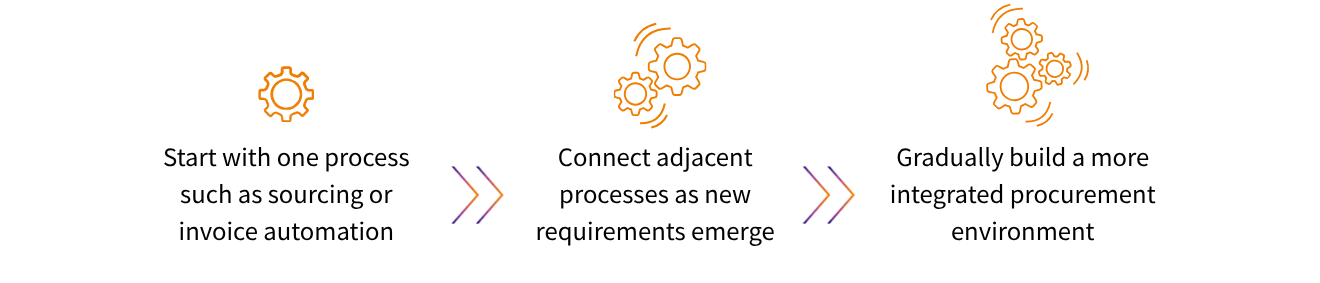
This approach reduces risk while still allowing organizations to move toward greater transparency and control over time.
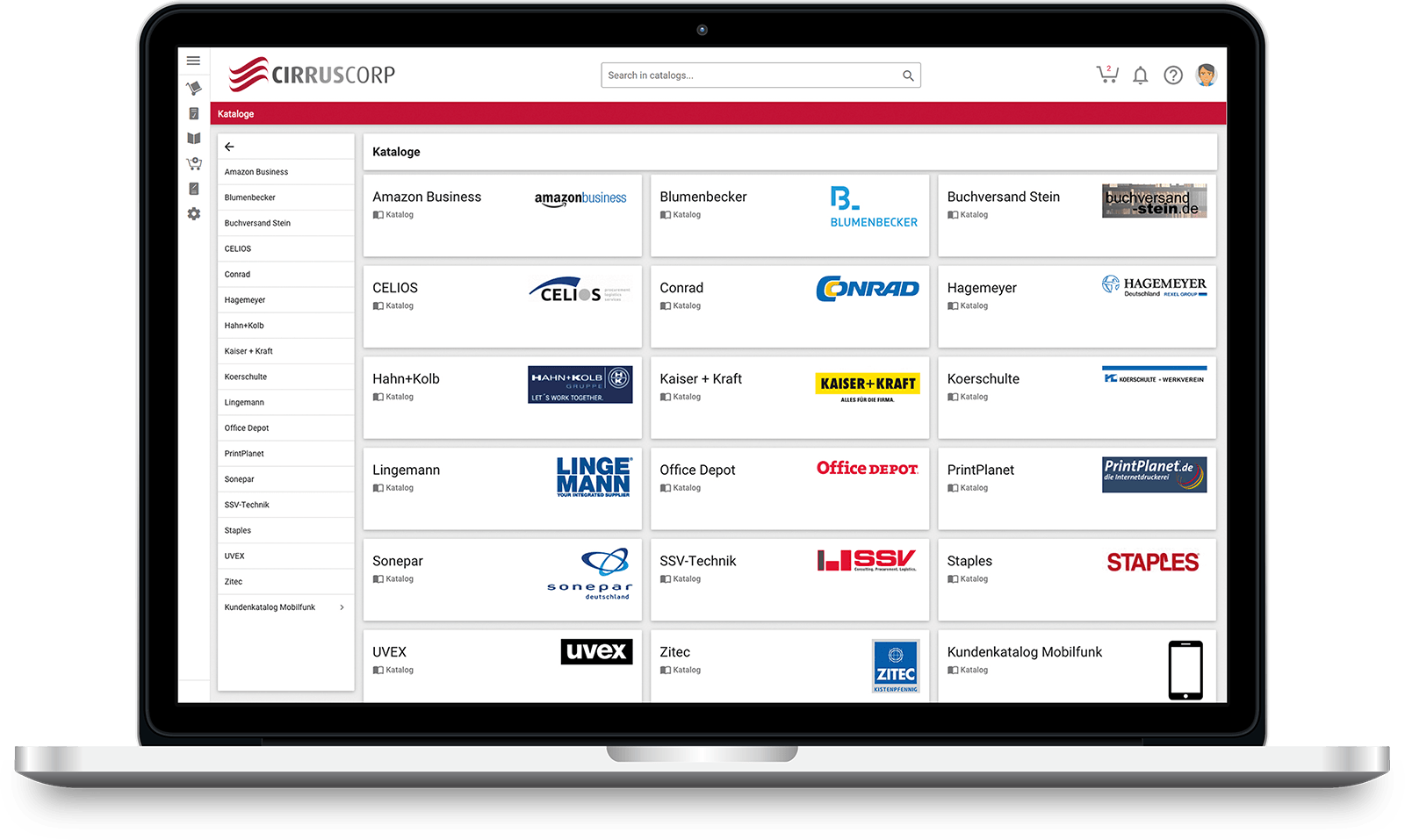
Solutions like Onventis reflect this direction. The platform combines sourcing, supplier management, contract management, procure-to-pay, and analytics in one system, while still allowing a modular entry point depending on the organization’s priorities.
What this means for procurement teams
Point solutions continue to play an important role, especially when immediate improvements are needed in a specific area. They enable fast progress and often serve as a practical entry point into procurement digitization. However, as requirements grow, integration becomes more critical, as visibility, compliance, and efficiency depend on how well processes and data are connected.
At the same time, many vendors have built S2P suites by acquiring point solutions. While this creates broad functionality on paper, these “suites” often remain loosely connected, leading to inconsistent user experiences and fragmented data. As a result, organizations may end up with a solution that appears integrated but still functions like a collection of separate tools.
Conclusion: Which approach is better?
The question is no longer strictly whether to choose point solutions or an S2P suite. It depends on your starting point, priorities, and long-term vision. If you need quick wins and have a very specific challenge, point solutions in procurement can be a logical first step. If your goal is long-term efficiency, control, and scalability, an integrated S2P approach becomes increasingly valuable.
The reality: flexibility and integration no longer need to be mutually exclusive.
Modern platforms, such as modular S2P solution, allow organizations to start with focused improvements and evolve toward a connected system over time. This means you don’t have to choose upfront between flexibility and integration. You can adopt a phased approach without locking yourself into a fragmented landscape.
Point solutions in procurement will continue to play a role, especially when addressing immediate challenges. But as procurement becomes more data-driven, strategic, and interconnected, the value of bringing processes together becomes increasingly clear.